


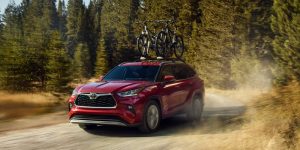
Choosing between the Highlander and 4Runner is less about specs and more about mindset. One is engineered to make daily driving feel effortless. The other is built to shrug off terrain that would make most SUVs turn around politely. Around Kinston, that distinction matters more than you might expect.
Powertrain Character and Everyday Behavior
The 2026 Toyota Highlander leans into refinement. Its 2.4 L Turbocharged engine produces 265 hp and 310 lbs. ft. of torque, paired with an 8-speed automatic transmission that prioritizes smooth, predictable power delivery. Standard AWD adds confidence in wet or variable conditions, making it well suited to commuting and longer highway drives.
The 2026 Toyota 4Runner approaches things differently. Also powered by a 2.4 L Turbocharged engine, it produces 278 hp and 317 lbs. ft. of torque, but the delivery feels more deliberate. Body-on-frame construction and available 4WD systems give it a sense of durability that becomes obvious the moment the pavement ends.
If your driving happens mostly on-road, the Highlander feels composed and efficient. If your weekends regularly involve dirt, rocks, or uneven ground, the 4Runner starts to make a stronger case.
Interior Space and Practical Usability
The Highlander is unapologetically family-focused. Seating for up to 8 and a maximum cargo capacity of approximately 84.3 cubic feet create a flexible, comfortable environment for passengers and luggage alike. The layout feels modern, with available premium materials and a clean integration of technology that supports longer journeys.
The 4Runner takes a more utilitarian approach. It offers seating for up to 7 with an available third row, and maximum cargo capacity reaches roughly 90.2 cubic feet. Materials are designed to handle wear more than impress at first glance, which makes sense for drivers who expect mud, gear, and unpredictable conditions to be part of the experience.
One prioritizes comfort and polish. The other prioritizes durability and ease of cleanup.
Technology and Safety Approach
Both SUVs benefit from Toyota Safety Sense™ 3.0, which includes Pre-Collision System with Pedestrian Detection, Lane Tracing Assist, Road Sign Assist, and Full-Speed Range Dynamic Radar Cruise Control. These systems provide a consistent safety foundation across both models.
Where they begin to separate is in presentation. The Highlander offers a more modern interface, including an available 12.3-inch touchscreen, head-up display, and wireless charging. It feels aligned with drivers who expect seamless connectivity.
The 4Runner keeps things more straightforward. Technology is present and functional, but it avoids unnecessary complexity, focusing instead on reliability and ease of use in demanding environments.
Capability vs Versatility in Real Conditions
The Highlander excels as a versatile midsize SUV. It handles daily errands, school runs, and highway travel with a calm, controlled demeanor. Its AWD system enhances traction but remains tuned for road use rather than trail exploration.
The 4Runner is purpose-built for off-road capability. Features such as Crawl Control and Multi-Terrain Select, combined with higher ground clearance, allow it to operate confidently in environments that would challenge most crossovers. It is less about refinement and more about resilience.
This is the core difference. The Highlander adapts to life. The 4Runner is ready for terrain.
Compare Highlander and 4Runner at Massey Toyota
Drivers in Kinston deciding between the 2026 Toyota Highlander and 2026 Toyota 4Runner will find that the right choice becomes clear once priorities are defined. Visiting Massey Toyota offers the opportunity to experience both approaches firsthand and determine which SUV aligns naturally with your driving habits, expectations, and sense of adventure.
Connect with us

